Showing posts with label Afghanistan. Show all posts

Saturday, July 10, 2010

Germany begins Afghan pullout in 2011

from : http://www.presstv.ir

Sat, 10 Jul 2010 04:30:03 GMT
Font size :
Germany aims to begin handing over security responsibilities to Afghan local forces in at least one of the country's northern provinces by 2011.
The German Foreign Minister says the country aims to begin handing over responsibility for security for Afghanistan's northern provinces to local forces next year.

In a statement to the Bundestag, or lower house of parliament on Friday, German Foreign Minister Guido Westerwelle said Germany should transfer at least one of the nine provinces it controls in the war-torn country by 2011, Reuters reported.

"We want to create the conditions within this legislative period that will allow the step-by-step withdrawal of our military presence," he said.

The address came days ahead of an international conference on the region, to be held in the Afghan capital Kabul on July 20.

"Only the Afghan government itself can make peace with those they are fighting," Westerwelle said. "It's also the task of the international community to bring Afghanistan's neighbors into this process."

According to polls, the majority of the German population thinks the country should withdraw from Afghanistan, where some 4,600 soldiers are stationed.

Many lawmakers in the German ruling coalition believe the center-right government will have to take a considerable move towards bringing the troops home before the next federal election in 2013.

Westerwelle said Afghanistan cannot be stabilized by military or humanitarian means alone, but requires a political solution.

Despite an increase in the US-led forces deployed in Afghanistan, which now stands at approximately 140,000, the Taliban are stronger than they have been since their government's ouster in 2001.

MVZ/TG/MVZ


The views expressed in this article are the sole responsibility of the author and do not necessarily reflect those of this website.

.

Monday, June 7, 2010

Russia Orders Troops To Prepare For War With US

from : http://www.eutimes.net


Reports circulating in the Kremlin today state that Prime Minister Putin has ordered Russian military forces to prepare to confront American military forces in Afghanistan over what Deputy Prime Minister Sergei Ivanov warns is the greatest threat to International peace and security, Afghanistan’s thriving drug trade supported by the US and NATO.

Not being reported to the American people about the Afghanistan war is that it has nothing to do with their being protected from terrorists, but rather it involves the billions of dollars gained for many of the West’s top intelligence agencies (mainly the CIA) from the heroin produced in this region (90% of World’s total) that by 2001 the Taliban had virtually eliminated.

Immediately after the US invasion of Afghanistan in October, 2001, the Central Intelligence Agency (CIA) installed one of their main Afghan operatives, Hamid Karzai, as President, who then put into power his brother Ahmed Wali Karzai, who since then has increased heroin production to levels unseen in modern times and resulting in the deaths of tens of thousands of Russian citizens.

Viktor Ivanov, the head of Russia’s Federal Drug Control Service, Russia’s National drug enforcement agency, told parliament in May that it was reasonable to “call the flow of Afghan opiates the second edition of opium wars.” Ivanov was referring to the 19th-century war between Britain and China sparked by exports of opium from British India to China.

Ivanov isn’t alone.

“I can name you a lot of politicians in Russia who said that the Americans specially arranged the situation in Afghanistan so that we would receive a lot of drugs, and this is the real aim of their occupation,” said Andrei Klimov, the deputy head of the foreign affairs committee in Russia’s lower house of parliament. “I’m not sure this is true, but who knows.”

One person who definitely knew it was true was German President Horst Koehler, who after returning from Afghanistan last month linked the war with the defense of German economic interests because it was securing free trade routes for the West and had nothing to do whatsoever with terrorism. For his “outspokenness” President Koehler was forced to resign plunging an already battered Chancellor Merkel into even greater political turmoil.

Most shocking to understand about the CIA’s being the World’s largest drug trafficker is that it isn’t even kept secret anymore and has been embraced by their new President, Barack Obama, who has used billions of dollars earned through Afghan heroin deals to fund his sending US Special Forces teams to over 75 different Nations as well as building for them a new $100 million headquarters base in Afghanistan while his own citizens plunge deeper into poverty.

Important to note though is that Obama is far from being the first American President to embrace the drug trade as nearly all of his predecessors were likewise involved in starting and maintaining wars to keep the billions earned from this most despicable of crimes preying on the weakest people in their society, mainly the poor and people of colour.

For those few reporters seeking to inform the American people about this crime the hard and brutal lesson learned from the late Gary Webb’s blacklisting and suiciding by US intelligence agents after his revealing the CIA’s involvement in the drug trade presents a chilling example of what these monsters will do to protect themselves and their right to poison anyone they so choose.

Interesting to note too is that according to the head of the UN Office on Drugs and Crime, Antonio Maria Costa, said he has seen evidence that the proceeds of organized crime were “the only liquid investment capital” available to some banks on the brink of collapse last year. He said that a majority of the $352 Billion of drugs profits was absorbed into the economic system as a result.

Though the American people still ignore the crimes being perpetrated by their so called leaders, the lessons of their own history should not be lost upon them, especially when viewed in the light of the use of drug and alcohol laws used for mass imprisonment while at the same time instituting around them a draconian tyrannical society where all their freedoms will be stripped from them.

And for those American’s thinking that their life couldn’t get any worse? They couldn’t be more mistaken! For just this past week Obama’s Federal Trade Commission (FTC) released what they call a “staff discussion draft” of “potential policy recommendations to support the reinvention of journalism” wherein they called for doctrine of proprietary facts that would outlaw anyone writing or reporting on anything that happens unless they use the “facts” provided to them by the government.

But than again, and as the history of these American’s seems to show, with their massive government debt about to eclipse their Gross National Product (GDP) for the first time in history, their once vital Gulf of Mexico region succumbing to the World’s worst oil spill catastrophe, and their NASA scientists now warning that the “awakening” Sun may destroy everything anyway, maybe they truly can’t be told the truth and must be treated like the children they act like.


The views expressed in this article are the sole responsibility of the author and do not necessarily reflect those of this website.


.

Tuesday, May 25, 2010

Russia rebukes US over Afghan heroin output

from : http://en.rian.ru

11:5625/05/2010

Moscow has criticised US-led forces in Afghanistan for failing to eradicate heroin production and warned at the weekend that drug smuggling was endangering Russia’s national security.

Russia says production of heroin in Afghanistan has increased almost tenfold since the US-led invasion to oust the Taliban began in 2001.

By Isabel Gorst in Moscow

Read more on http://www.ft.com/cms/s/0/032fba50-672a-11df-bf08-00144feab49a.html


The views expressed in this article are the sole responsibility of the author and do not necessarily reflect those of this website.

.

Tuesday, May 4, 2010

US deploys 1000 drones in Afghanistan

from : http://www.presstv.ir

Tue, 04 May 2010 07:38:17 GMT
Font size :
A US Predator drone flies over the moon above Kandahar Air Field, southern Afghanistan.
The US is deploying thousands of drones in Afghanistan, raising suspicions as to whether the move is aimed at monitoring militants or targeting another country.

Regional defense analysts believe that the unmanned aerial vehicles could be brought into play against regional countries in the wake of mounting tensions with Iran over its nuclear activities, the Pakistan Observer newspaper reported on Tuesday.

Deputy Director for Resources and Acquisition for the Pentagon's Joint Staff, Marine Corps Brig. Gen. Glenn Walters, recently said that the American military has sent a host of its 6,500 drones to the Middle East region.

He further noted that even though the US Pacific Command, Southern Command and Africa Command are in dire need of more UAVs, they are obliged to wait until the demand is met at the Central Command.

Walters also pointed out that the American military, whose UAV fleet has grown from about 200 since the beginning of the US-led war in Afghanistan, will have to specify as to what to do with the drones, as the wars in Iraq and Afghanistan allegedly come to a close.

MP/TG/HRF


The views expressed in this article are the sole responsibility of the author and do not necessarily reflect those of this website..

Sunday, May 2, 2010

Fox News Makes Excuse for CIA’s Afghan Opium Cultivation

from : http://www.uruknet.info

Kurt Nimmo

9opium18522.jpg

Infowars.com, May 2, 2010

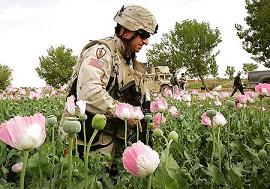
In an amazing propaganda segment, Fox News’ Gerald Rivera talks with an occupation soldier about U.S. support of the opium trade in Afghanistan. The soldier tells Rivera he does not like supporting Afghan opium production. The U.S., he insists, has turned a blind eye to the cultivation because it is a cultural thing. He’d rather the Afghans grow watermelons.

Is it possible the U.S. will tell the brother of Afghanistan’s U.S.-installed ruler he should get in the watermelon business?

It was reported a few months ago that Ahmed Wali Karzai was on the CIA payroll and intimately involved in the opium trade Fox News and the rest of the corporate media tell us is run by the evil Taliban.

Fox News did not report that before everything changed on September 11, 2001, and before the U.S. invaded Afghanistan, the Taliban had imposed a ban on opium production. This resulted in opium production collapsing by more than 90 per cent. It was the U.S. supported Northern Alliance that came to the rescue and began protecting the production of raw opium.

"CIA-supported Mujahedeen rebels [who in 2001 were part of the Northern Alliance] engaged heavily in drug trafficking while fighting against the Soviet-supported government and its plans to reform the very backward Afghan society," William Blum writes in The Real Drug Lords.

Under the interim government of Hamid Karzai, opium poppy cultivation once again began to skyrocket and opium markets were restored. According to the United Nations Drug Control Program (UNDCP), opium cultivation increased by 657 per cent in 2002 in relation to its 2001 level. The UNDCP estimated 2002 opium poppy cultivation would cover an area between 45,000 and 65,000 hectares. Opium cultivation in 2001 had fallen to an estimated 7,606 hectares. According to the UN, in 2006 alone Afghanistan supplied 92 percent of the world’s supply of opium (see Apratim Mukarji’s Afghanistan: From Freedom to Terror, p. 22-23).

"The Golden Crescent drug trade, launched by the CIA in the early 1980s, continues to be protected by US intelligence, in liaison with NATO occupation forces and the British military. In recent developments, British occupation forces have promoted opium cultivation through paid radio advertisements," Michel Chossudovsky wrote in 2007.

"Respected people of Helmand. The soldiers of ISAF and ANA do not destroy poppy fields," the radio promo said. "They know that many people of Afghanistan have no choice but to grow poppy. ISAF and the ANA do not want to stop people from earning their livelihoods." This is basically the same excuse used by the soldier interviewed by Geraldo.

"Senior Bush Administration officials had displayed a complete lack of interest in the Afghan opium problem ever since 9/11," James Risen writes in State of War. "In fact, the White House and Pentagon went out of their way to avoid taking on the Afghan drug lords from the very outset of U.S. military operations in Afghanistan."

Not mentioned is the fact that more than 95 percent of the revenue generated by opium production is siphoned off to business syndicates, organized crime and banking and financial institutions.

"In many instances, drug money is currently the only liquid investment capital," said Vienna-based UNODC Executive Director Antonio Maria Costa said last January. "In the second half of 2008, liquidity was the banking system’s main problem and hence liquid capital became an important factor."

Former Managing Director and board member of Wall Street investment bank Dillon Read, Catherine Austin Fitts, has long alleged that the banksters launder imponderable amounts of drug money. "According to the Department of Justice, the US launders between $500 billion – $1 trillion annually. I have little idea what percentage of that is narco dollars, but it is probably safe to assume that at least $100-200 billion relates to US drug import-exports and retail trade," writes Fitts.

The CIA has long secured the lucrative global drug market for Wall Street and for its own operational "off-the-books" purposes. "The CIA’s operational directorate, in other words that’s their covert operations, para-military, dirty tricks — call it whatever you want — has for at least 40 years that we can document paid for a significant amount of its work through the sales of heroin and cocaine," Guerrilla News Network reported in an interview with Christopher Simpson.

The CIA has been in the drug running business since the 1950s. In Burma, Vietnam, Laos, Latin America, and Afghanistan, the CIA — also known as the "Cocaine Import Agency" — has remained at the forefront of the international illicit drug trade. The journalist Gary Webb and the San Jose Mercury News tied the CIA and the Contras to a large crack cocaine ring in Los Angeles. Webb paid with his life for revealing this information to the public.

None of this was mentioned by Geraldo Rivera and Fox News. Instead we are told drug dealing in Afghanistan is something engaged in by the evil Taliban (a group of religious fanatics created by the CIA and its partner, Pakistin’s ISI intelligence service).

Not that the Taliban are innocent — they have abandoned their old ways and are now exploiting the opium bumper crop to fund their operations.

"Curbing the Taliban’s multimillion dollar opium poppy business was a major goal of a military operation to seize this former insurgent stronghold," the Associated Press reported in March. "If they destroy the crops and curb the trade, they lose the support of the population — a problem for which they have no easy solution."

Support of the population, of course, comes in a far distant second to maintaining the addiction of Wall Street and the CIA to billions of dollars in profit.


:: Article nr. 65610 sent on 03-may-2010 00:36 ECT
www.uruknet.info?p=65610

The views expressed in this article are the sole responsibility of the author and do not necessarily reflect those of this website.

.

Saturday, April 24, 2010

German troops in Afghanistan call on Angela Merkel to explain why they're at war

from : www.dailymail.co.uk

By Mail Foreign Service
Last updated at 4:12 PM on 21st April 2010

Angela Merkel

Under pressure: German troops are calling on Chancellor Angela ( LOT name "Ferkel"instead of Merkel means "little pig" )Merkel to tell them why they're at war in Afghanistan

German soldiers are wearing their hearts on their sleeves - in the form of a badge that protests their country's involvement in the war in Afghanistan.

Some troops have taken to wearing the cloth accessory that states - ironically - 'I fight for Merkel' in a bid to persuade the German Chancellor Angela Merkel to explain exactly what they are fighting and dying for.

Four more troops were killed, and five badly injured, in Afghanistan last week.

Seven soldiers have died there so far this month, bringing the total to 43 in all since they were first deployed eight years ago.

Unable to engage the Taliban directly on the ground, frustrated by their government’s inability to acknowledge they are even engaged in a war and angered by the lack of popular support for their mission, the badges are a low-key mutiny that has sent shock waves through the top brass of the Bundeswehr.

Soldiers were warned this week that it is illegal to sew the cloth patches on to their uniforms.

But that hasn’t stopped them from buying the badges in their hundreds, in desert beige or NATO green, at the ISAF camp at Mazar-e-Sharif.

'They want the Chancellor, their ultimate boss, to finally find the clear words to put the war against the Taliban into black and white,' Bild Zeitung, Germany’s biggest daily paper, said today.

Chancellor Merkel is to make a statement to parliament tomorrow. Her spokesman said she wants to make clear her 'high-esteem' for the work of the German soldiers in Afghanistan in the light of the recent casualties.

But she will be speaking in the Reichstag after being put under pressure from U.S. General Stanley McChrystal, who arrived in Germany today with a brief from the White House to get the Germans to do more in Afghanistan.

Germany has the third largest presence in Afghanistan after the U.S. and Britain. The German parliament approved the dispatch of a further 850 soldiers in February when it extended the mandate for the military mission.

Yet the political will for German troops to engage the enemy head-on remains lacking.

Cracks are growing in the parties that supported their engagement there up until now.
Ottmar Schreiner, a left-wing member of the opposition Social Democratic Party (SPD), said his party has 'growing doubts' about German involvement in Afghanistan.

He said: 'If things haven't improved in Afghanistan by next year then I don't see where a majority for a new extension of the mandate is going to come from.'

The trouble for Mrs Merkel is that German involvement is deeply unpopular with some 80 per cent of the public, who want the troops to come home. Germany’s disastrous wars of the last century have left its public with a deep pacifistic streak.

The German press has been swift to condemn the government for its indecisiveness.

The Financial Times Deutschland said: 'With every dead German soldier in Afghanistan, the calls for an immediate withdrawal grow louder. This reflex shows that the German public is still not clear about the character of the mission.

'The politicians are largely to blame. Since the beginning of the mission eight years ago they suppressed a realistic description of the situation... Deaths, injuries, battles and heavy weaponry -- none of these suit the picture that was painted back then.'

The left-wing Berliner Zeitung said: 'Why are German soldiers in Afghanistan at all? As the chancellor and her government are still sticking to the military mission there it is their duty to explain it. But she has failed to do so.

'This can be explained by her basic attitude - it is only worth talking about problems when they become virulent.

'In the case of Afghanistan this is particularly catastrophic. Because the government has failed to make its case in what is the biggest foreign policy and security policy challenge in the history of the Federal Republic of Germany.'


Read more: http://www.dailymail.co.uk/news/worldnews/article-1267802/German-troops-Afghanistan-Angela-Merkel-explain-theyre-war.html#ixzz0m3wuxA6D


The views expressed in this article are the sole responsibility of the author and do not necessarily reflect those of this website..

Tuesday, April 20, 2010

The Afghan War: "No Blood for Opium"

from : http://www.globalresearch.ca

The Hidden Military Agenda is the Protect the Drug Trade


Global Research, April 21, 2010


0diggsdigg
StumbleUpon Submit

It was common during the opening of the Iraq war to see slogans proclaiming “No blood for oil!” The cover story for the war – Saddam’s links with Al Qaida and his weapons of mass destruction – were obvious mass deceptions, hiding a far less palatable imperial agenda. The truth was that Iraq was a major producer of oil and, in our age, the Age of Oil, oil is the most strategic resource of all. For many it was obvious that the real agenda of the war was an imperialistic grab for Iraqi oil. This was confirmed when Iraq’s state-owned oil company was privatised to western interests in the aftermath of the invasion.

Why then are there no slogans saying “No blood for opium!”? Afghanistan’s major product is opium and opium production has increased remarkably during the present war. The current NATO action around Marjah is clearly motivated by opium. It is reported to be Afghanistan’s main opium-producing area. Why then won’t people consider that the real agenda of the Afghan war has been control of the opium trade?

The weapons of mass deception tell us that the opium belongs to the Taliban and that the US is fighting a war on drugs as well as terror. Yet it remains a curious fact that the opium trade has tracked across Southern Asia for the past five decades from east to west, following US wars, and always under the control of US assets.

In the 1960s, when the US fought a secret war in Laos using the Hmong opium army of Vang Pao as its proxy, Southeast Asia produced 70% of the world’s illicit opium. After the Soviet invasion of Afghanistan, Afghanistan production, controlled by US-backed drug lords, took off, till it rivalled Southeast Asian production. Since 2002, Afghan opium production, encouraged by both the Taliban and US-backed drug lords, has reached 93% of world illicit production, an unparalleled performance.

The graph below from the UN World Drug Report 2008 shows the astonishing increase in Afghan opium production that followed the US invasion.


In the 1980s the US supported Islamic fundamentalists, the Mujahideen, against the Soviets in Afghanistan. To pay for their war, the Mujahideen ordered peasants to grow opium as a revolutionary tax. Across the border in Pakistan, Afghan leaders and local syndicates, under the protection of Pakistani Intelligence, operated hundreds of heroin labs. As the Golden Crescent in Southwest Asia eclipsed the Golden Triangle in Southeast Asia as the centre of the heroin trade, it sent rates of addiction spiralling in Afghanistan, Iran, Pakistan and the Soviet Union.

To hide US complicity in the drug trade, Drug Enforcement Agency (DEA) officers were required to look away from the drug-dealing intrigues of the US allies and the support they received from Pakistan’s Inter Service Intelligence (ISI) and the services of Pakistani banks. The CIA’s mission was to destabilise the Soviet Union through the promotion of militant Islam inside the Central Asian Republics and they sacrificed the drug war to fight the Cold War. Their mission was to do as much damage as possible to the Soviets. Knowing the drug war would hasten the collapse of the Soviet Union, the CIA facilitated the operation of anti-Soviet rebels in the provinces of Uzbekistan, Chechnya and Georgia. Drugs were used to finance terrorism and western intelligence agencies used their control of drugs to influence political factions in Central Asia.

The Soviet army withdrew from Afghanistan in 1989, leaving a civil war between the US-funded mujahideen and the Soviet-supported government that raged until 1992. In the chaos that followed the mujahideen victory, Afghanistan lapsed into a period of warlordism in which opium growing thrived.

The Taliban emerged from the chaos, dedicated to removing the war lords and applying a strict interpretation of Sharia law. They captured Kandahar in 1994, and expanded their control throughout Afghanistan, capturing Kabul in 1996, and declaring the Islamic Emirate of Afghanistan.

Under the policies of the Taliban government, opium production in Afghanistan was curbed. In September 1999, the Taliban authorities issued a decree, requiring all opium-growers in Afghanistan to reduce output by one-third. A second decree, issued in July 2000, required farmers to completely stop opium cultivation. Ordering the ban on opium growing, Taliban leader Mullah Omar called the drug trade “un-Islamic”.

As a result, 2001 was the worst year for global opium production in the period between 1990 and 2007. During the 1990s, global opium production averaged over 4000 tonnes. In 2001, opium production fell to less than 200 tonnes. Although it was not admitted by the Howard government, which claimed the credit itself, Australia’s 2001 heroin shortage was due to the Taliban.

Following the attack on the Pentagon and the World Trade Centre on 11 September 2001, the armies of the northern alliance, led by US Special Forces, supported by daisy cutters, cluster bombs and bunker-busting missiles, shattered the Taliban forces in Afghanistan. The opium ban was lifted and, with CIA-backed warlords back in control, Afghanistan again became the major producer of opium. Despite the official denials, Hillary Mann Leverett, a former US National Security Council official for Afghanistan, confirmed that the US knew that government ministers in Afghanistan, including the minister of defence in 2002, were involved in drug trafficking.

After 2002 Afghan opium production rose to unheard of levels. By 2007, Afghanistan was producing enough heroin to supply the entire world. In 2009, Thomas Schweich, who served as US state department co-ordinator for counter-narcotics and justice reform for Afghanistan, accused President Hamid Karzai of impeding the war on drugs. Schweich also accused the Pentagon of obstructing attempts to get military forces to assist and protect opium crop eradication drives.

Schweich wrote in the New York Times that "narco-corruption went to the top of the Afghan government". He said Karzai was reluctant to move against big drug lords in his political power base in the south, where most of the country's opium and heroin is produced.

The most prominent of these suspected drug lords was Ahmed Wali Karzai, the brother of President Hamid Karzai. Ahmed Wali Karzai was said to have orchestrated the manufacture of hundreds of thousands of phony ballots for his brother’s re-election effort in August 2009. He was also believed to have been responsible for setting up dozens of so-called ghost polling stations — existing only on paper — that were used to manufacture tens of thousands of phony ballots. US officials have criticised his “mafia-like” control of southern Afghanistan. The New York Times reported that the Obama administration had vowed to crack down on the drug lords who permeate the highest levels of President Karzai’s administration, and they pressed President Karzai to move his brother out of southern Afghanistan, but he refused to do so.

"Karzai was playing us like a fiddle," Schweich wrote. "The US would spend billions of dollars on infrastructure development; the US and its allies would fight the Taliban; Karzai's friends could get richer off the drug trade. Karzai had Taliban enemies who profited from drugs but he had even more supporters who did."

But who was playing who like a fiddle?

Was it the puppet President or the puppet masters who installed him?

As Douglas Valentine shows in his history of the War on Drugs, The Strength of the Pack, this never-ending war has been a phony contest, an arm wrestle between two arms of the US state, the DEA and the CIA; with the DEA vainly attempting to prosecute the war, while the CIA protects its drug-dealing assets.

During the Nineteenth and Twentieth centuries, European powers (chiefly the UK) and Japan used the opium trade to weaken and subjugate China. During the Twenty-First century, it seems that the opium weapon is being used against Iran, Russia and the former Soviet republics, which all face spiralling rate of addiction and covert US penetration as the Afghan War fuels central Asia’s heroin plague.


Dr John Jiggens is the author of “The killer cop and the murder of Donald Mackay”.


Global Research Articles by John Jiggens


The views expressed in this article are the sole responsibility of the author and do not necessarily reflect those of this website.

.

Saturday, April 3, 2010

NATO’s Afghanistan: The Champion of Drugs Production

from : http://uruknet.com

Timothy Bancroft-Hinchey

afghan-opium_war1.jpg

April 2, 2010 – Pravda.ru

We really have to take our hats off to NATO. This clique of arms lobbyists and defender of jobs for the boys invaded Afghanistan in 2001 on the pretext that Osama bin Laden was using the country to attack western interests. Almost a decade after the Taleban declared war on drugs production, NATO’s Afghanistan is not only the world’s largest producer of opium but now, of hashish also.

Mullah Omar, the leader of the Taleban, had stated in an interview with Pakistan’s Dawn newspaper in 1998 that the USA would invade Afghanistan because he had refused to let them build a gas pipeline across his country in exchange for 5 billion USD. He was right. The invasion came three years later after those two jets flew into the Twin Towers, that one jet crash-landed in the Pentagon, managing to avoid two lamp posts with its wings and to fail to produce a single piece of evidence either on camera or otherwise and then there was the other one that simply disintegrated without trace.

Like 200 tonnes of metal vaporised.

No, really.

And nearly ten years later, NATO’s considerable coalition has not managed to gain control of the country, the NATO-installed President, Karzai, is railing against his NATO masters because he has been accused of corruption and considers it is their fault (no really) and now we learn from the United Nations Organization that NATO’s Afghanistan, already the world’s leading supplier of opium, has now become the record-breaking producer of hashish as well.

Wow, NATO 2 world population 0. Is this why they insisted on expanding eastwards (after saying they wouldn’t) to create new markets?

The UN Office on Drugs and Crime (UNODC), in its report Afghanistan Cannabis Survey, released on Wednesday, estimated that between 10 and 24 thousand hectares of cannabis per year are cultivated in Afghanistan. Not only is the figure shocking, worse still is the affirmation that this production takes place in half of the country’s 34 provinces.

UNODC Executive Director Antonio Maria Costa declared in the report that "the astonishing yield of the Afghan cannabis crop makes Afghanistan the world’s biggest producer of hashish, estimated at between 1,500 and 3,500 tons a year," being 145 kg per hectare, compared with Morocco’s 40 kg. Cannabis fetches 3,900 USD in income per hectare, compared with opium’s 3,600 USD.
The UN report states that there are both cannabis and opium trading centres throughout the country.

So what exactly is NATO doing in Afghanistan, where the Taleban was supposed to surrender ten years ago and still has not, where heroin production has risen no less than 40 times in the same period and now Afghanistan’s claim to fame is world record holder of opium and cannabis production?


The views expressed in this article are the sole responsibility of the author and do not necessarily reflect those of this website.

.

Thursday, March 4, 2010

Marine reportedly killed by opium-fueled private contractors

from : http://rawstory.com

By John Byrne
Thursday, March 4th, 2010 -- 9:43 am

Pentagon originally said Marine killed in combat

The Pentagon confirmed late Tuesday that it is investigating the death of a 24-year-old Indiana Marine after he was shot to death in Afghanistan, allegedly by several US-paid private security contractors.

The contractors, according to a fellow Marine in Afghanistan who communicated with an investigative reporter in Chicago, were Afghanis who were found with "copious amounts of opium" and had been paid by the United States as guards.

"He was killed by American Hired Local National Contractors that were high on opium the morning of the 19th," the ABC reporter quotes a friend and fellow colleague of Lance Corporal Joshua Birchfield as saying in an email message.

Lance Corporal Joshua Birchfield was killed after being shot in the head Feb. 19. The Department of Defense originally reported that he died of "small arms fire" while in combat.

Story continues below...

But the story is apparently darker and more complex -- raising questions of whether the Pentagon originally concealed information about the Marine's death.

The Chicago Marine who tipped off the ABC reporter purportedly wrote a detailed email surrounding the circumstances of Birchfield's death. In it, he asserts that the young Marine was killed by Afghanis paid as private contractors.

"These men are armed to the teeth and supposedly here for our protection," the fellow Marine is said to have emailed. "We have been shot at by the contractors on several cases before this incident. We have been told to refrain from returning fire and attempt to identify ourselves as Marines so they stop shooting."

"They are also drug abusers," he continued. "The shooter was found to have copious amounts of wet opium on him shortly after the shooting ... we found a bag of wet opium in the compound that the contractors were using to get high."

"A mix of drugs and gray areas of loyalty between U.S. forces and Taliban seems to be the motivation behind the shooting," he added.

The Pentagon, announcing an investigation into the death on Wednesday, declined to say what exactly they were investigating.

Pentagon spokesman Geoff Morrell told the Associated Press "the military is looking into the circumstances surrounding the Feb. 19 shooting of 24-year-old Lance Cpl. Joshua Birchfield of Westville. He declined further comment."

"Maj. Carl Redding of the Marine Corps confirmed the investigation but referred additional questions to Marine Corps officials in Afghanistan," the AP added.

Investigators reportedly found the private security guards with drugs and weapons and placed several under arrest.

ABC reporter Chuck Goudie wrote about Birchfield's death in a column in the local newspaper The Daily Herald. Curiously, his column includes the caveat, "The views in this column are his own and not those of WLS-TV." WLS-TV is an ABC affiliate.

Goudies says Birchfield "was on a security patrol about a half-mile from a Marine forward operating base. About 7 a.m., as day broke, shots were fired at Birchfield's patrol team, according to members of his unit. The ambush was by U.S.-hired security guards who were supposed to be protecting a highway paving project from Taliban-installed roadside bombs."

"The contractors were able to have such proximity to a U.S. patrol because we pay them to work on our FOB (forward operating base), pave the 515 (highway), and provide security from Taliban IED (roadside bomb) implacers in the area," he says he was told.


The views expressed in this article are the sole responsibility of the author and do not necessarily reflect those of this website.

.

Friday, February 19, 2010

The death of a child or adult in Afghanistan is worth $1,500-$2,500


from : http://www.sott.net

Christopher Torchia
Associated Press
Fri, 19 Feb 2010 22:17 EST
The fallout of war has a price in southern Afghanistan.

U.S. Army units fighting the Taliban in Helmand province have a compensation system for any death, injury or damage to crops and buildings caused by American forces to Afghan civilians and their property.

The suffering of a population caught between combatants during the Afghan war is a politically sensitive issue, and NATO troops have sought to make amends for deadly airstrikes and other instances in which civilians were killed.

In turn, they accuse insurgents of using civilians as human shields, making it harder to distinguish between enemies and innocents. Financial compensation in desperately poor Afghanistan is at least one way to alleviate distress and show good intentions, military commanders say.

The American units carry a list that gives guidance on payouts:

The death of a child or adult is worth $1,500-$2,500, loss of limb and other injuries $600-$1,500, a damaged or destroyed vehicle $500-$2,500, and damage to a farmer's fields $50-$250.

The system is also useful for gathering intelligence on insurgents, says 1st Sgt. Gene Hicks of Tacoma, Washington.

The military pays villagers in local currency for information about the location of roadside bombs as well as "where they've seen people at, where they've seen people moving, where they've seen people shooting from," Hicks said.

His Alpha Company of 1st Battalion, 17th Infantry Regiment of the 5th Stryker Brigade has paid out nearly $500 so far, though they also have yet to compensate landowners for compounds they have occupied and turned into patrol bases. They have not had to pay any "condolence" payments for injury or loss of life.

One Afghan landowner stands to reap a windfall because his compound has been occupied by British, Canadian and American troops.

"They've all used the same compound," Hicks said. "So he gets his money from whoever's occupying his compound at the time."

It's not an exact science, but some Afghan civilians in the area of Badula Qulp, northeast of the contested Taliban stronghold of Marjah, have been quick to exploit it. In any casualty case, the Americans are mindful that they might be asked to compensate for the death of an insurgent, rather than a civilian.

"It's really kind of hard," Hicks said. "You have to determine whether the guy was a good guy or a bad guy. It's a benefit of the doubt kind of thing."

A few days ago, a company with the 4th Battalion, 23rd Infantry Regiment got into a firefight with the Taliban, and a helicopter destroyed a mosque from where troops had received fire. The 15-year-old son of the local religious figure died in the air strike; the U.S. military agreed to pay compensation in a meeting with village leaders, though commanders privately speculated that the son might have been a combatant.

At that meeting, one of the elders initially objected to the idea of putting a price on someone's death, or damage to a holy religious site. By the end of the meeting, the elders seemed content with the idea of a payout.

The compensation process requires completed claim forms, and is sometimes complicated by the fact that many villagers don't know how to write and can't sign their names. In that event, soldiers take their fingerprint on the document or photograph them with the form.

During a mission in neighboring Kandahar province, Alpha Company once ran into an enterprising man who showed them where to find a roadside bomb that could have caused serious damage to one of their Stryker infantry carriers. The man wouldn't settle for a few hundred dollars; he wanted the amount of the armored vehicle that had possibly been saved from destruction - a cool $2 million or more.

He didn't get it.

The views expressed in this article are the sole responsibility of the author and do not necessarily reflect those of this website.

.

Friday, February 5, 2010

Flashback :WHAT YOUR CHILDREN ARE DYING FOR IN AFGHANISTAN

.

wiki says :

http://en.wikipedia.org/wiki/War_in_Afghanistan_%282001%E2%80%93present%29#Drug_trade

In 2000, the Taliban had issued a ban on opium production, which led to reductions in Pashtun Mafia opium production by as much as 90%.[291] Soon after the 2001 U.S. led invasion of Afghanistan, however, opium production increased markedly.[292] By 2005, Afghanistan had regained its position as the world’s #1 opium producer and was producing 90% of the world’s opium, most of which is processed into heroin and sold in Europe and Russia.[293] Afghan opium kills 100,000 people every year worldwide.[294]

artikel starts :


from : what really happened (blog) ( Int.

The Taliban had all but eradicated the opium growers before the US invasion. So why is cheap Afghani heroin flooding into the United States?

file:///D:/MIKE/WEB_DEVEL/WRH/IMAGES/_44614216_picgall7.jpg

file:///D:/MIKE/WEB_DEVEL/WRH/IMAGES/afghan_opium0430.jpg


In Afghan fields the poppies grow.
Between the crosses.
Row on row.

1998 Unocal Statement:
Suspension of activities related to proposed
natural gas pipeline across Afghanistan

As a result of sharply deteriorating political conditions in the region, Unocal, which serves as the development manager for the Central Asia Gas (CentGas) pipeline consortium, has suspended all activities involving the proposed pipeline project in Afghanistan.

From the 1998 Congressional Record.
Emphasis added to text.

U.S. INTERESTS IN THE CENTRAL ASIAN
REPUBLICS HEARING BEFORE THE
SUBCOMMITTEE ON ASIA AND THE PACIFIC
OF THE COMMITTEE ON INTERNATIONAL
RELATIONS HOUSE OF REPRESENTATIVES

ONE HUNDRED FIFTH CONGRESS SECOND SESSION
FEBRUARY 12, 1998

Next we would like to hear from Mr. John J. Maresca, vice president of international relations, Unocal Corporation. You may proceed as you wish.

STATEMENT OF JOHN J. MARESCA, VICE
PRESIDENT OF INTERNATIONAL RELATIONS, UNOCAL CORPORATION

Mr. Maresca. Thank you, Mr. Chairman. It's nice to see you again. I am John Maresca, vice president for international relations of the Unocal Corporation. Unocal, as you know, is one of the world's leading energy resource and project development companies. I appreciate your invitation to speak here today. I believe these hearings are important and timely. I congratulate you for focusing on Central Asia oil and gas reserves and the role they play in shaping U.S. policy.

I would like to focus today on three issues. First, the need for multiple pipeline routes for Central Asian oil and gas resources. Second, the need for U.S. support for international and regional efforts to achieve balanced and lasting political settlements to the conflicts in the region, including Afghanistan. Third, the need for structured assistance to encourage economic reforms and the development of appropriate investment climates in the region. In this regard, we specifically support repeal or removal of section 907 of the Freedom Support Act.

Mr. Chairman, the Caspian region contains tremendous untapped hydrocarbon reserves. Just to give an idea of the scale, proven natural gas reserves equal more than 236 trillion cubic feet. The region's total oil reserves may well reach more than 60 billion barrels of oil. Some estimates are as high as 200 billion barrels. In 1995, the region was producing only 870,000 barrels per day. By 2010, western companies could increase production to about 4.5 million barrels a day, an increase of more than 500 percent in only 15 years. If this occurs, the region would represent about 5 percent of the world's total oil production.

One major problem has yet to be resolved: how to get the region's vast energy resources to the markets where they are needed. Central Asia is isolated. Their natural resources are land locked, both geographically and politically. Each of the countries in the Caucasus and Central Asia faces difficult political challenges. Some have unsettled wars or latent conflicts. Others have evolving systems where the laws and even the courts are dynamic and changing. In addition, a chief technical obstacle which we in the industry face in transporting oil is the region's existing pipeline infrastructure.

Because the region's pipelines were constructed during the Moscow-centered Soviet period, they tend to head north and west toward Russia. There are no connections to the south and east. But Russia is currently unlikely to absorb large new quantities of foreign oil. It's unlikely to be a significant market for new energy in the next decade. It lacks the capacity to deliver it to other markets.

Two major infrastructure projects are seeking to meet the need for additional export capacity. One, under the aegis of the Caspian Pipeline Consortium, plans to build a pipeline west from the northern Caspian to the Russian Black Sea port of Novorossiysk. Oil would then go by tanker through the Bosporus to the Mediterranean and world markets.

The other project is sponsored by the Azerbaijan International Operating Company, a consortium of 11 foreign oil companies, including four American companies, Unocal, Amoco, Exxon and Pennzoil. This consortium conceives of two possible routes, one line would angle north and cross the north Caucasus to Novorossiysk. The other route would cross Georgia to a shipping terminal on the Black Sea. This second route could be extended west and south across Turkey to the Mediterranean port of Ceyhan.

But even if both pipelines were built, they would not have enough total capacity to transport all the oil expected to flow from the region in the future. Nor would they have the capability to move it to the right markets. Other export pipelines must be built.

At Unocal, we believe that the central factor in planning these pipelines should be the location of the future energy markets that are most likely to need these new supplies. Western Europe, Central and Eastern Europe, and the Newly Independent States of the former Soviet Union are all slow growth markets where demand will grow at only a half a percent to perhaps 1.2 percent per year during the period 1995 to 2010.

Asia is a different story all together. It will have a rapidly increasing energy consumption need. Prior to the recent turbulence in the Asian Pacific economies, we at Unocal anticipated that this region's demand for oil would almost double by 2010. Although the short-term increase in demand will probably not meet these expectations, we stand behind our long-term estimates.

I should note that it is in everyone's interest that there be adequate supplies for Asia's increasing energy requirements. If Asia's energy needs are not satisfied, they will simply put pressure on all world markets, driving prices upwards everywhere.

The key question then is how the energy resources of Central Asia can be made available to nearby Asian markets. There are two possible solutions, with several variations. One option is to go east across China, but this would mean constructing a pipeline of more than 3,000 kilometers just to reach Central China. In addition, there would have to be a 2,000-kilometer connection to reach the main population centers along the coast. The question then is what will be the cost of transporting oil through this pipeline, and what would be the netback which the producers would receive.

For those who are not familiar with the terminology, the netback is the price which the producer receives for his oil or gas at the well head after all the transportation costs have been deducted. So it's the price he receives for the oil he produces at the well head.

The second option is to build a pipeline south from Central Asia to the Indian Ocean. One obvious route south would cross Iran, but this is foreclosed for American companies because of U.S. sanctions legislation. The only other possible route is across Afghanistan, which has of course its own unique challenges. The country has been involved in bitter warfare for almost two decades, and is still divided by civil war. From the outset, we have made it clear that construction of the pipeline we have proposed across Afghanistan could not begin until a recognized government is in place that has the confidence of governments, lenders, and our company.

Mr. Chairman, as you know, we have worked very closely with the University of Nebraska at Omaha in developing a training program for Afghanistan which will be open to both men and women, and which will operate in both parts of the country, the north and south.

Unocal foresees a pipeline which would become part of a regional system that will gather oil from existing pipeline infrastructure in Turkmenistan, Uzbekistan, Kazakhstan and Russia. The 1,040-mile long oil pipeline would extend south through Afghanistan to an export terminal that would be constructed on the Pakistan coast. This 42-inch diameter pipeline will have a shipping capacity of one million barrels of oil per day. The estimated cost of the project, which is similar in scope to the trans-Alaska pipeline, is about $2.5 billion.

Given the plentiful natural gas supplies of Central Asia, our aim is to link gas resources with the nearest viable markets. This is basic for the commercial viability of any gas project. But these projects also face geopolitical challenges. Unocal and the Turkish company Koc Holding are interested in bringing competitive gas supplies to Turkey. The proposed Eurasia natural gas pipeline would transport gas from Turkmenistan directly across the Caspian Sea through Azerbaijan and Georgia to Turkey. Of course the demarcation of the Caspian remains an issue.

Last October, the Central Asia Gas Pipeline Consortium, called CentGas, in which Unocal holds an interest, was formed to develop a gas pipeline which will link Turkmenistan's vast Dauletabad gas field with markets in Pakistan and possibly India. The proposed 790-mile pipeline will open up new markets for this gas, traveling from Turkmenistan through Afghanistan to Multan in Pakistan. The proposed extension would move gas on to New Delhi, where it would connect with an existing pipeline. As with the proposed Central Asia oil pipeline, CentGas can not begin construction until an internationally recognized Afghanistan Government is in place.

The Central Asia and Caspian region is blessed with abundant oil and gas that can enhance the lives of the region's residents, and provide energy for growth in both Europe and Asia. The impact of these resources on U.S. commercial interests and U.S. foreign policy is also significant. Without peaceful settlement of the conflicts in the region, cross-border oil and gas pipelines are not likely to be built. We urge the Administration and the Congress to give strong support to the U.N.-led peace process in Afghanistan. The U.S. Government should use its influence to help find solutions to all of the region's conflicts.

U.S. assistance in developing these new economies will be crucial to business success. We thus also encourage strong technical assistance programs throughout the region. Specifically, we urge repeal or removal of section 907 of the Freedom Support Act. This section unfairly restricts U.S. Government assistance to the government of Azerbaijan and limits U.S. influence in the region.

Developing cost-effective export routes for Central Asian resources is a formidable task, but not an impossible one. Unocal and other American companies like it are fully prepared to undertake the job and to make Central Asia once again into the crossroads it has been in the past. Thank you, Mr. Chairman.


US Policy On Taliban Influenced By Oil Deal Negotiations

The two claim that the US government's main objective in Afghanistan was to consolidate the position of the Taliban regime to obtain access to the oil and gas reserves in Central Asia.

They affirm that until August [2001], the US government saw the Taliban regime "as a source of stability in Central Asia that would enable the construction of an oil pipeline across Central Asia" from the rich oilfields in Turkmenistan, Uzbekistan, and Kazakhstan, through Afghanistan and Pakistan, to the Indian Ocean. Until now, says the book, "the oil and gas reserves of Central Asia have been controlled by Russia. The Bush government wanted to change all that."


Click image for full size

But, confronted with Taliban's refusal to accept US conditions, "this rationale of energy security changed into a military one", the authors claim.

"At one moment during the negotiations, the US representatives told the Taliban, 'either you accept our offer of a carpet of gold, or we bury you under a carpet of bombs,'" Brisard said in an interview in Paris.


The US government informed other nations of it's plan
to invade Afghanistan months before the 9/11 attacks

9 September 2001: Bush given Afghanistan invasion plan

7 October 2001: Bush announces opening of Afghanistan attacks

13 June 2002: Hamid Karzai Elected as New Afghan Leader
(Former Unocal Consultant)

27 December 2002: Afghanistan Pipeline Deal signed

An agreement has been signed in the Turkmen capital, Ashgabat, paving the way for construction of a gas pipeline from the Central Asian republic through Afghanistan to Pakistan.

The building of the trans-Afghanistan pipeline has been under discussion for some years but plans have been held up by Afghanistan's unstable political situation.


The views expressed in this article are the sole responsibility of the author and do not necessarily reflect those of this website.

.

Monday, January 4, 2010

Flashback :WHAT OUR CHILDREN ARE DYING FOR IN AFGHANISTAN

from : what really happened (blog) ( Int. )

The Taliban had all but eradicated the opium growers before the US invasion. So why is cheap Afghani heroin flooding into the United States?

file:///D:/MIKE/WEB_DEVEL/WRH/IMAGES/_44614216_picgall7.jpg

file:///D:/MIKE/WEB_DEVEL/WRH/IMAGES/afghan_opium0430.jpg


In Afghan fields the poppies grow.
Between the crosses.
Row on row.

1998 Unocal Statement:
Suspension of activities related to proposed
natural gas pipeline across Afghanistan

As a result of sharply deteriorating political conditions in the region, Unocal, which serves as the development manager for the Central Asia Gas (CentGas) pipeline consortium, has suspended all activities involving the proposed pipeline project in Afghanistan.

From the 1998 Congressional Record.
Emphasis added to text.

U.S. INTERESTS IN THE CENTRAL ASIAN
REPUBLICS HEARING BEFORE THE
SUBCOMMITTEE ON ASIA AND THE PACIFIC
OF THE COMMITTEE ON INTERNATIONAL
RELATIONS HOUSE OF REPRESENTATIVES

ONE HUNDRED FIFTH CONGRESS SECOND SESSION
FEBRUARY 12, 1998

Next we would like to hear from Mr. John J. Maresca, vice president of international relations, Unocal Corporation. You may proceed as you wish.

STATEMENT OF JOHN J. MARESCA, VICE
PRESIDENT OF INTERNATIONAL RELATIONS, UNOCAL CORPORATION

Mr. Maresca. Thank you, Mr. Chairman. It's nice to see you again. I am John Maresca, vice president for international relations of the Unocal Corporation. Unocal, as you know, is one of the world's leading energy resource and project development companies. I appreciate your invitation to speak here today. I believe these hearings are important and timely. I congratulate you for focusing on Central Asia oil and gas reserves and the role they play in shaping U.S. policy.

I would like to focus today on three issues. First, the need for multiple pipeline routes for Central Asian oil and gas resources. Second, the need for U.S. support for international and regional efforts to achieve balanced and lasting political settlements to the conflicts in the region, including Afghanistan. Third, the need for structured assistance to encourage economic reforms and the development of appropriate investment climates in the region. In this regard, we specifically support repeal or removal of section 907 of the Freedom Support Act.

Mr. Chairman, the Caspian region contains tremendous untapped hydrocarbon reserves. Just to give an idea of the scale, proven natural gas reserves equal more than 236 trillion cubic feet. The region's total oil reserves may well reach more than 60 billion barrels of oil. Some estimates are as high as 200 billion barrels. In 1995, the region was producing only 870,000 barrels per day. By 2010, western companies could increase production to about 4.5 million barrels a day, an increase of more than 500 percent in only 15 years. If this occurs, the region would represent about 5 percent of the world's total oil production.

One major problem has yet to be resolved: how to get the region's vast energy resources to the markets where they are needed. Central Asia is isolated. Their natural resources are land locked, both geographically and politically. Each of the countries in the Caucasus and Central Asia faces difficult political challenges. Some have unsettled wars or latent conflicts. Others have evolving systems where the laws and even the courts are dynamic and changing. In addition, a chief technical obstacle which we in the industry face in transporting oil is the region's existing pipeline infrastructure.

Because the region's pipelines were constructed during the Moscow-centered Soviet period, they tend to head north and west toward Russia. There are no connections to the south and east. But Russia is currently unlikely to absorb large new quantities of foreign oil. It's unlikely to be a significant market for new energy in the next decade. It lacks the capacity to deliver it to other markets.

Two major infrastructure projects are seeking to meet the need for additional export capacity. One, under the aegis of the Caspian Pipeline Consortium, plans to build a pipeline west from the northern Caspian to the Russian Black Sea port of Novorossiysk. Oil would then go by tanker through the Bosporus to the Mediterranean and world markets.

The other project is sponsored by the Azerbaijan International Operating Company, a consortium of 11 foreign oil companies, including four American companies, Unocal, Amoco, Exxon and Pennzoil. This consortium conceives of two possible routes, one line would angle north and cross the north Caucasus to Novorossiysk. The other route would cross Georgia to a shipping terminal on the Black Sea. This second route could be extended west and south across Turkey to the Mediterranean port of Ceyhan.

But even if both pipelines were built, they would not have enough total capacity to transport all the oil expected to flow from the region in the future. Nor would they have the capability to move it to the right markets. Other export pipelines must be built.

At Unocal, we believe that the central factor in planning these pipelines should be the location of the future energy markets that are most likely to need these new supplies. Western Europe, Central and Eastern Europe, and the Newly Independent States of the former Soviet Union are all slow growth markets where demand will grow at only a half a percent to perhaps 1.2 percent per year during the period 1995 to 2010.

Asia is a different story all together. It will have a rapidly increasing energy consumption need. Prior to the recent turbulence in the Asian Pacific economies, we at Unocal anticipated that this region's demand for oil would almost double by 2010. Although the short-term increase in demand will probably not meet these expectations, we stand behind our long-term estimates.

I should note that it is in everyone's interest that there be adequate supplies for Asia's increasing energy requirements. If Asia's energy needs are not satisfied, they will simply put pressure on all world markets, driving prices upwards everywhere.

The key question then is how the energy resources of Central Asia can be made available to nearby Asian markets. There are two possible solutions, with several variations. One option is to go east across China, but this would mean constructing a pipeline of more than 3,000 kilometers just to reach Central China. In addition, there would have to be a 2,000-kilometer connection to reach the main population centers along the coast. The question then is what will be the cost of transporting oil through this pipeline, and what would be the netback which the producers would receive.

For those who are not familiar with the terminology, the netback is the price which the producer receives for his oil or gas at the well head after all the transportation costs have been deducted. So it's the price he receives for the oil he produces at the well head.

The second option is to build a pipeline south from Central Asia to the Indian Ocean. One obvious route south would cross Iran, but this is foreclosed for American companies because of U.S. sanctions legislation. The only other possible route is across Afghanistan, which has of course its own unique challenges. The country has been involved in bitter warfare for almost two decades, and is still divided by civil war. From the outset, we have made it clear that construction of the pipeline we have proposed across Afghanistan could not begin until a recognized government is in place that has the confidence of governments, lenders, and our company.

Mr. Chairman, as you know, we have worked very closely with the University of Nebraska at Omaha in developing a training program for Afghanistan which will be open to both men and women, and which will operate in both parts of the country, the north and south.

Unocal foresees a pipeline which would become part of a regional system that will gather oil from existing pipeline infrastructure in Turkmenistan, Uzbekistan, Kazakhstan and Russia. The 1,040-mile long oil pipeline would extend south through Afghanistan to an export terminal that would be constructed on the Pakistan coast. This 42-inch diameter pipeline will have a shipping capacity of one million barrels of oil per day. The estimated cost of the project, which is similar in scope to the trans-Alaska pipeline, is about $2.5 billion.

Given the plentiful natural gas supplies of Central Asia, our aim is to link gas resources with the nearest viable markets. This is basic for the commercial viability of any gas project. But these projects also face geopolitical challenges. Unocal and the Turkish company Koc Holding are interested in bringing competitive gas supplies to Turkey. The proposed Eurasia natural gas pipeline would transport gas from Turkmenistan directly across the Caspian Sea through Azerbaijan and Georgia to Turkey. Of course the demarcation of the Caspian remains an issue.

Last October, the Central Asia Gas Pipeline Consortium, called CentGas, in which Unocal holds an interest, was formed to develop a gas pipeline which will link Turkmenistan's vast Dauletabad gas field with markets in Pakistan and possibly India. The proposed 790-mile pipeline will open up new markets for this gas, traveling from Turkmenistan through Afghanistan to Multan in Pakistan. The proposed extension would move gas on to New Delhi, where it would connect with an existing pipeline. As with the proposed Central Asia oil pipeline, CentGas can not begin construction until an internationally recognized Afghanistan Government is in place.

The Central Asia and Caspian region is blessed with abundant oil and gas that can enhance the lives of the region's residents, and provide energy for growth in both Europe and Asia. The impact of these resources on U.S. commercial interests and U.S. foreign policy is also significant. Without peaceful settlement of the conflicts in the region, cross-border oil and gas pipelines are not likely to be built. We urge the Administration and the Congress to give strong support to the U.N.-led peace process in Afghanistan. The U.S. Government should use its influence to help find solutions to all of the region's conflicts.

U.S. assistance in developing these new economies will be crucial to business success. We thus also encourage strong technical assistance programs throughout the region. Specifically, we urge repeal or removal of section 907 of the Freedom Support Act. This section unfairly restricts U.S. Government assistance to the government of Azerbaijan and limits U.S. influence in the region.

Developing cost-effective export routes for Central Asian resources is a formidable task, but not an impossible one. Unocal and other American companies like it are fully prepared to undertake the job and to make Central Asia once again into the crossroads it has been in the past. Thank you, Mr. Chairman.


US Policy On Taliban Influenced By Oil Deal Negotiations

The two claim that the US government's main objective in Afghanistan was to consolidate the position of the Taliban regime to obtain access to the oil and gas reserves in Central Asia.

They affirm that until August [2001], the US government saw the Taliban regime "as a source of stability in Central Asia that would enable the construction of an oil pipeline across Central Asia" from the rich oilfields in Turkmenistan, Uzbekistan, and Kazakhstan, through Afghanistan and Pakistan, to the Indian Ocean. Until now, says the book, "the oil and gas reserves of Central Asia have been controlled by Russia. The Bush government wanted to change all that."


Click image for full size

But, confronted with Taliban's refusal to accept US conditions, "this rationale of energy security changed into a military one", the authors claim.

"At one moment during the negotiations, the US representatives told the Taliban, 'either you accept our offer of a carpet of gold, or we bury you under a carpet of bombs,'" Brisard said in an interview in Paris.


The US government informed other nations of it's plan
to invade Afghanistan months before the 9/11 attacks

9 September 2001: Bush given Afghanistan invasion plan

7 October 2001: Bush announces opening of Afghanistan attacks

13 June 2002: Hamid Karzai Elected as New Afghan Leader
(Former Unocal Consultant)

27 December 2002: Afghanistan Pipeline Deal signed

An agreement has been signed in the Turkmen capital, Ashgabat, paving the way for construction of a gas pipeline from the Central Asian republic through Afghanistan to Pakistan.

The building of the trans-Afghanistan pipeline has been under discussion for some years but plans have been held up by Afghanistan's unstable political situation.


The views expressed in this article are the sole responsibility of the author and do not necessarily reflect those of this website.

.