Showing posts with label economics. Show all posts

Thursday, May 6, 2010

USA : Senate rejects proposal to break up largest banks

from : http://www.reuters.com

(Reuters) - The Senate Thursday rejected a proposal that would split up the six largest banks in an effort to ensure that large financial firms do not threaten the economy if they fail.

The measure, which failed by a vote of 33 to 61, would have placed hard limits on banks' market share of insured deposits and limited the size of their non-deposit liabilities.


The views expressed in this article are the sole responsibility of the author and do not necessarily reflect those of this website.

.

US Stocks extend plunge almost 1000 points on concerns about Greece

from : http://www.sott.net

Tom Paradis
Associated Press
Thu, 06 May 2010 17:35 EDT

© AP Photo/Henny Ray Abrams
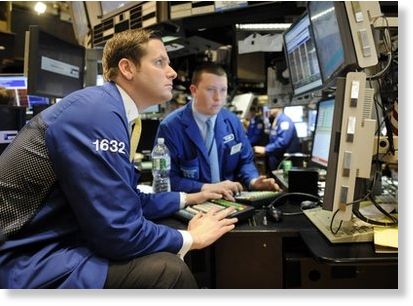
Traders work on floor, in New York

Traders work on the floor of the New York Stock Exchange, Thursday, May 6, 2010, in New York. It was a painful flashback to the darkest days of 2008: Stocks plunged and the Dow Jones industrials skidded by hundreds of points as traders succumbed to fears that Greece's debt problems would halt the global economic recovery.
The stock market had one of its most turbulent days in history as the Dow Jones industrials dropped almost 1,000 points in less than half an hour on fears that Greece's debt problems could halt the global economic recovery.

The market's plunge came less than 90 minutes before the end of trading. The Dow's drop was its largest loss ever during the course of a trading day, but it recovered to a loss of 347 at the close. All the major indexes lost more than 3 percent.

There were reports that the sudden drop was caused by a trader who mistyped an order to sell a large block of stock. The drop in that stock's price was enough to trigger "sell" orders across the market.

Still, the Dow was already down more than 200 points as traders watched protests in the streets of Athens on TV. Protestors raged against austerity measures passed by the Greek parliament. But traders were not comforted by the fact that Greece seemed to be working towards a resolution of its debt problems. Instead, they focused on the possibility that other European countries would also run into trouble, and that the damage to their economies could spread to the U.S.

"The market is now realizing that Greece is going to go through a depression over the next couple of years," said Peter Boockvar, equity strategist at Miller Tabak. "Europe is a major trading partner of ours, and this threatens the entire global growth story."

The stock market has had periodic bouts of anxiety about the European economies during the past few months. They have intensified over the past week even as Greece appeared to be moving closer to getting a bailout package from some of its neighbors.

Computer trading intensified the losses as programs designed to sell stocks at a specified level kicked in. Traders use those programs to try to limit their losses when the market is falling. And the selling only led to more selling as prices fell.

"I think the machines just took over. There's not a lot of human interaction," said Charlie Smith, chief investment officer at Fort Pitt Capital Group. "We've known that automated trading can run away from you, and I think that's what we saw happen today."

On the floor of the New York Stock Exchange, stone-faced traders huddled around electronic boards and televisions, silently watching and waiting. Traders' screens were flashing numbers non-stop, with losses shown in solid blocks of red numbers.

The impact on some stocks was enormous although brief. Stock in the consulting firm Accenture fell to 4 cents after closing at $42.17 on Wednesday. It closed at $41.09, down just over $1.

NYSE spokesman Raymond Pellecchia said the plunge wasn't caused by a problem with the exchange's trading systems. The Nasdaq Stock Market said it was reviewing its trades with other trading networks.

Even if there were technical issues, emotions about the world economy were running high. Down 998.50 points in its largest point drop ever, the Dow recovered two-thirds of that amount but still had its biggest point loss since February 2009.

The Dow has lost 631 points, or more than 5 percent, in three days amid worries about Greece. That is its largest three-day percentage drop since March 2009, when the stock market was nearing its bottom following the financial crisis.

The losses were so widespread that just 173 stocks rose on the NYSE, compared to 3,008 that fell. The major indexes were all down more than 3 percent.

Meanwhile, interest rates on Treasurys soared as traders sought the safety of U.S. government debt. The yield on the benchmark 10-year note, which moves opposite its price, fell to 3.4 percent from late Wednesday's 3.54 percent.
Print

related :

Panic on Wall Street as Dow Plummets 9% Over Fears for Global Financial System .


The views expressed in this article are the sole responsibility of the author and do not necessarily reflect those of this website .

.

Sunday, February 14, 2010

Bombshell: Goldman Sachs Helped Greece Cover Up Its Huge Debt

from : http://www.economicpolicyjournal.com

NYT is out with a major story by Louise Story, Landon Thomas and Nelson D. Schwartz on how Goldman Sachs, Morgan Stanley and other investment banks have helped Greece hide the extent of its debt:
As worries over Greece rattle world markets, records and interviews show that with Wall Street’s help, the nation engaged in a decade-long effort to skirt European debt limits. One deal created by Goldman Sachs helped obscure billions in debt from the budget overseers in Brussels.

Even as the crisis was nearing the flashpoint, banks were searching for ways to help Greece forestall the day of reckoning. In early November — three months before Athens became the epicenter of global financial anxiety — a team from Goldman Sachs arrived in the ancient city with a very modern proposition for a government struggling to pay its bills, according to two people who were briefed on the meeting.

The bankers, led by Goldman’s president, Gary D. Cohn, held out a financing instrument that would have pushed debt from Greece’s health care system far into the future, much as when strapped homeowners take out second mortgages to pay off their credit cards.

It had worked before. In 2001, just after Greece was admitted to Europe’s monetary union, Goldman helped the government quietly borrow billions, people familiar with the transaction said. That deal, hidden from public view because it was treated as a currency trade rather than a loan, helped Athens to meet Europe’s deficit rules while continuing to spend beyond its means.

Athens did not pursue the latest Goldman proposal, but with Greece groaning under the weight of its debts and with its richer neighbors vowing to come to its aid, the deals over the last decade are raising questions about Wall Street’s role in the world’s latest financial drama.

As in the American subprime crisis and the implosion of the American International Group, financial derivatives played a role in the run-up of Greek debt. Instruments developed by Goldman Sachs, JPMorgan Chase and a wide range of other banks enabled politicians to mask additional borrowing in Greece, Italy and possibly elsewhere.

In dozens of deals across the Continent, banks provided cash upfront in return for government payments in the future, with those liabilities then left off the books. Greece, for example, traded away the rights to airport fees and lottery proceeds in years to come.

Critics say that such deals, because they are not recorded as loans, mislead investors and regulators about the depth of a country’s liabilities.

Some of the Greek deals were named after figures in Greek mythology. One of them, for instance, was called Aeolos, after the god of the winds.
Most alarming is the hint that this goes beyond Greece:
Such derivatives, which are not openly documented or disclosed, add to the uncertainty over how deep the troubles go in Greece and which other governments might have used similar off-balance sheet accounting.
Bottom line: It appears that Goldman Sachs has turned many governments throughout the world into Super-Enrons, with off-balance sheet shenanigans, financial sleight of hand and convoluted accounting. Governments generally don't need help in this kind of maneuvering, but Goldman with its collection of whiz kid derivative designers has taken the entire process to a new level. A new level so unique that it could very will collapse the financial structure of the manipulated world. Posted by Robert Wenzel at 1:17 PM


The views expressed in this article are the sole responsibility of the author and do not necessarily reflect those of this website.

.

Sunday, January 24, 2010

Vatican bank charged with money-laundering

from : http://www.presstv.ir


Sun, 24 Jan 2010 10:34:44 GMT
Font size :

The Bank of the Vatican has been accused of laundering USD 200 million by proxy through an Italian creditor, a report indicates.

The allegation of the Vatican bank's financial corruption has been made by an Italian magazine that pointed to the financial institute's purported involvement in stealth fiscal transactions —via several accounts —with Italy's UniCredit Bank, Russia Today television network quoted the Panorama magazine as reporting.

“This corruption is continuing on a regular basis in the Vatican,” claimed Janathan Levy, a lawyer familiar with the bank.

“Again, there's no reason for a religion to have a bank that does worldwide commercial activities, dealing in gold, dealing in insurance, dealing in property and then hiding behind the Roman Catholic Church," Levy pointed out.

“I had the privilege to walk inside this bank. It's nothing like a bank,” the Russian news channel quoted another lawyer, Massimiliano Gabrieli, as saying.

“If you go there you deposit or withdraw money without limit, without any kind of receipt for the bank and for the client. All you have is a single card with a number,” he stated.

The British London Telegraph, has recently ranked the Bank of the Vatican ahead of the Bahamas, Switzerland and Liechtenstein in banking secrecy.

The Vatican has denied all charges.

GHN/JG


The views expressed in this article are the sole responsibility of the author and do not necessarily reflect those of this website.

.

Tuesday, January 19, 2010

Yummy! Ammonia -Treated Pink Slime Now in Most U.S. Ground Beef


from : http://www.sott.net

Jennifer Poole
Alternet
Fri, 01 Jan 2010 23:03 EST

You're not going to believe what millions of Americans have been eating the last few years (Thanks, Bush! Thanks meat industry lobbyists!).

You're not going to believe what you've been eating the last few years (thanks, Bush! thanks meat industry lobbyists!) when you eat a McDonald's burger (or the hamburger patties in kids' school lunches) or buy conventional ground meat at your supermarket:

According to today's New York Times, The "majority of hamburger" now sold in the U.S. now contains fatty slaughterhouse trimmings "the industry once relegated to pet food and cooking oil," "typically including most of the material from the outer surfaces of the carcass" that contains "larger microbiological populations."

This "nasty pink slime," as one FDA microbiologist called it, is now wrung in a centrifuge to remove the fat, and then treated with AMMONIA to "retard spoilage," and turned into "a mashlike substance frozen into blocks or chips".

Thus saving THREE CENTS a pound off production costs. And making the company, Beef Products Inc., a fortune. $440 million/year in revenue. Ain't that something?

And to emphasize: this pink slime isn't just in fast food burgers or free lunches for poor kids:
With the U.S.D.A.'s stamp of approval, the company's processed beef has become a mainstay in America's hamburgers. McDonald's, Burger King and other fast-food giants use it as a component in ground beef, as do grocery chains. The federal school lunch program used an estimated 5.5 million pounds of the processed beef last year alone.
Bush's U.S.D.A. also allowed these "innovators" to get away with listing the ammonia as "a processing agent" instead of by name. And they also OKd the processing method -- and later exempted the hamburger from routine testing of meat sold to the general public - strictly based on the company's claims of safety, which were not backed by any independent testing.

Because the ammonia taste was so bad ("It was frozen, but you could still smell ammonia," said Dr. Charles Tant, a Georgia agriculture department official. "I've never seen anything like it.") the company started using a less alkaline ammonia treatment, and now we know - thanks to testing done for the school lunch program - that the nasty stuff isn't even reliably killing the pathogens.

But government and industry records obtained by The New York Times show that in testing for the school lunch program, E. coli and salmonella pathogens have been found dozens of times in Beef Products meat, challenging claims by the company and the U.S.D.A. about the effectiveness of the treatment. Since 2005, E. coli has been found 3 times and salmonella 48 times, including back-to-back incidents in August in which two 27,000-pound batches were found to be contaminated. The meat was caught before reaching lunch-rooms trays.

In July, school lunch officials temporarily banned their hamburger makers from using meat from a Beef Products facility in Kansas because of salmonella - the third suspension in three years, records show. Yet the facility remained approved by the U.S.D.A. for other customers.

Presented by The Times with the school lunch test results, top [U.S.D.A.] department officials said they were not aware of what their colleagues in the lunch program had been finding for years.

The New York Times article today has a rather innocuous headline, "Safety of beef processing method is questioned."

I'd say this quote from the U.S.D.A. department microbiologist, Gerald Zirnstein, who called the processed beef "pink slime" in a 2002 e-mail message to colleagues, represents the situation better: "I do not consider the stuff to be ground beef, and I consider allowing it in ground beef to be a form of fraudulent labeling."

I've been thinking about an action item on this issue, and I've got three ideas:
  1. Write Michelle Obama through this web form: here or snail mail: The White House, 1600 Pennsylvania Avenue NW, Washington, DC 20500

  2. Print out the NY Times article and give it to the manager of your local supermarket, and ask them if they sell any kind of ground beef that doesn't contain this "pink slime" or if their butchers will grind meat fresh for you

  3. Just stop buying the damned stuff altogether.


The views expressed in this article are the sole responsibility of the author and do not necessarily reflect those of this website.

.